
Bark Beetles in Arizona: Why the Pines Turn Red
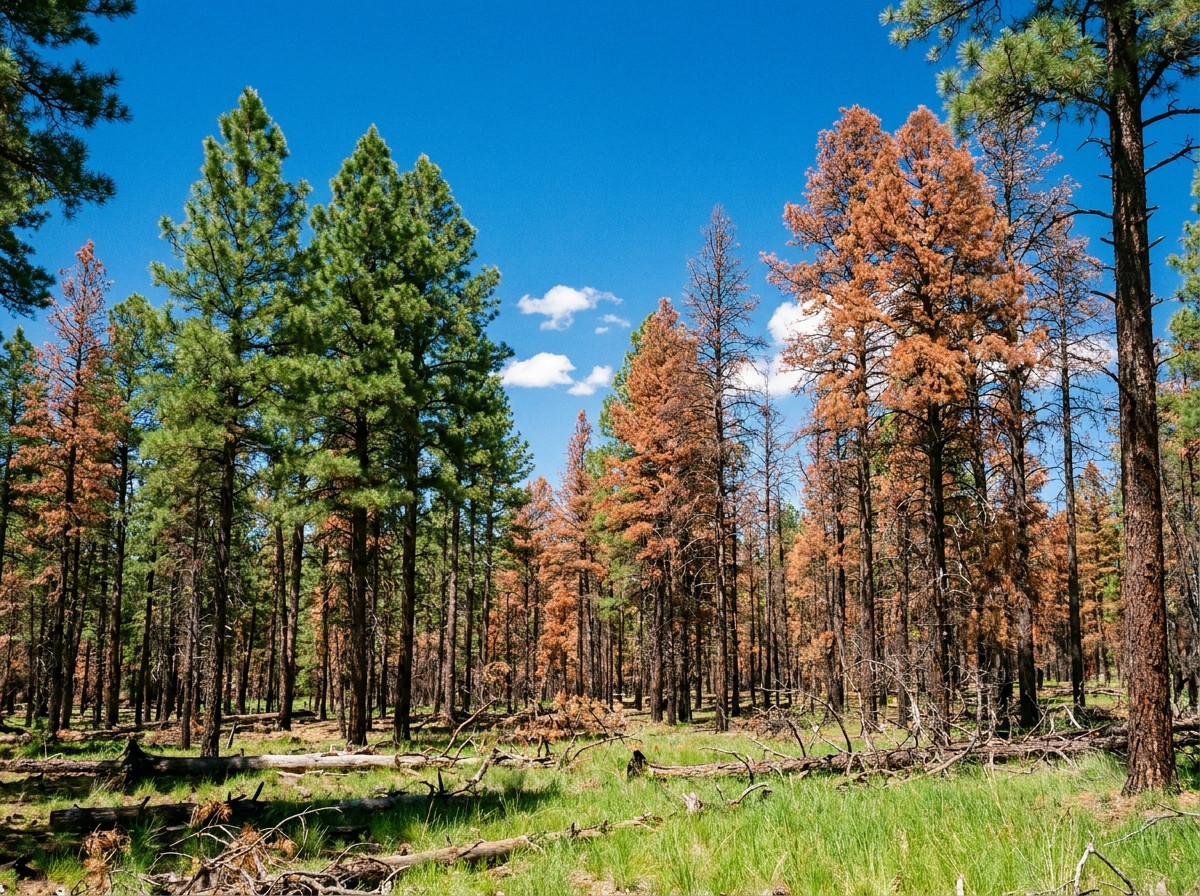
Drive the Mogollon Rim in late summer and you will see them: patches of rust-red pine scattered through the green. It looks like fall arriving early, or a fire that never happened. It is neither. Those trees are the visible end of a bark beetle attack that has been underway, out of sight, for months.
Bark beetles are native to Arizona's forests. They have been here as long as the pines have, and in a normal year they mostly finish off trees that are already weakened or dying. Problems start when drought, crowded stands and mild winters tip the odds toward the beetle. Then a few red trees become a pocket, and a pocket spreads along an entire hillside.
What a bark beetle actually does
An adult beetle flies to a pine, bores under the bark and lays eggs. The larvae feed on the inner tissue that carries water and nutrients up the tree. A single tree can host thousands of developing beetles, and when they emerge they fly to the trees next door.
It is basically girdling the tree. Cut off that vascular tissue and the tree cannot move water, so it dies. Most of the damage happens out of sight, and by the time the crown fades to red, the beetles that killed the tree are often already gone.
The beetles you will meet in Arizona
Mountain pine beetle. The one behind most of the red you will see in ponderosa pine. It hit Arizona hard during the drought of the early 2000s, especially in the ponderosa on the Mogollon Rim, the White Mountains and the Kaibab Plateau.
Pinyon ips beetle. Smaller, and it attacks pinyon pine. The same drought killed pinyons across the Southwest by the millions, turning whole pinyon-juniper slopes gray-brown almost overnight.
Spruce beetle. The high-country specialist, working Engelmann spruce on the Kaibab and the North Rim.
Western pine beetle and fir engraver. The quieter ones, in ponderosa and true fir.
Why it happens now
A forest that is too dense, plus warmer temperatures and drought, stresses the trees. A stressed pine cannot pitch out an attacking beetle the way a healthy one can, and once enough beetles hit it, it cannot defend itself.
Think of a garden where you planted too many seeds. Too many sprouts come up, and now they are all fighting for light and water. A crowded forest works the same way.
What land managers do about it
You are not going to stop it. The goal is to slow it down and keep the forest a forest.
In practice that means thinning crowded stands so the remaining trees have water and light, and cutting and removing infested trees before the next generation of beetles emerges. In the places people actually use - trailheads, campgrounds and day-use areas - the work is more like a scalpel: keep the big shade trees people camp and hammock under, and take out the ones that are already doomed or dangerous.
What it means for your hike
Dead trees eventually fall, and that is the real visitor risk: a standing dead pine near a trail or a campsite. Managers prioritize hazard trees in the places you go, which is why the tree leaning over your favorite picnic table tends to be the one that gets cut first.
You will also start seeing the signs once you know them. Look for pitch tubes, little blobs of resin where the tree tried to push a beetle back out; frass, the sawdust-like boring dust around the base; and small round exit holes in the bark. And of course the red crowns themselves, though a tree can be dead for a year before the needles fade.
Where you will see it in Arizona
- The Mogollon Rim and the Payson area for ponderosa pine, including the waterfall-canyon country.
- Flagstaff and the San Francisco Peaks for ponderosa.
- The Kaibab Plateau and North Rim for spruce and ponderosa.
- The pinyon-juniper country statewide for the ips beetle.
What to look for on the trail
- Pitch tubes on the trunk.
- Boring dust, or frass, at the base of the tree.
- A crown fading from green to yellow to red.
- Small round exit holes in the bark.
- And the one that matters most: do not camp or linger under a standing dead tree.
Questions people ask
Are these beetles invasive? No. They are native insects, and western forests evolved alongside them. The problem is the conditions, not a new arrival.
Is the forest dying? No. Outbreaks thin it. The goal is to keep it a forest, not to save every tree.
Should I cancel my hike? No. Trails stay open, and managers clear the hazard trees in the areas people use. Just do not linger under a dead one.
Does it happen every year? No. Outbreaks track drought. The last big one in Arizona followed the dry years of the early 2000s.
Can I tell a tree is doomed before it turns red? Sometimes. Pitch tubes and fresh boring dust are the early signs, and a tree that is pitching out resin may still be fighting off the attack.
Want to see the high country for yourself?
See Arizona hiking tours →Guided hikes across Arizona, including the Grand Canyon Scenic & Hiking Day Tour.